


Center for Human Frontiers
Engineered Reality
Engineering the Mind
The power of the mind to remake one’s own reality has been known for thousands of years.
This power is inscribed in our most ancient “technologies,” ranging from meditation and prayer to ritual percussion and movement, in traditions around the world. Current research is showing that these states of mind appear to promote neuroplasticity and, with it, greater potential for neurological healing, psychological improvement, accelerated learning, and a transformation of personal well being—a remapping of our reality, using the power of the mind.
Seeing the Big Picture
In the last hundred years, we’ve seen technology allow us to build global civilization and create unparalleled advances in medicine, science, and industry, yet at some point along the way technological progress was decoupled from helping us thrive. We suffer from anxiety, post-traumatic stress, and drug addiction more than ever before. Our minds are increasingly extending into our handheld devices and virtual alter egos, but with not without costs. We’ve lost track of the human in our vision for the future. This is where the Center for Human Frontiers intervenes.
The Engineering the Mind project recenters traditional wisdom and contemplative traditions as a source to develop and extend the most powerful qualities of the human mind with the aid of emerging technology. The goals are twofold:
- to advance our understanding of non-ordinary states of consciousness and their power for individual healing and collective cultural betterment, and;
- to create new biofeedback techniques for training and applying the miracles of the world’s deep cultural traditions for cultivating neuroplasticity to contemporary life.
The last ten years have seen a revolution in secular mindfulness practice as a tool to address myriad contemporary problems. Pharmacologically occasioned non-ordinary consciousness is showing tremedous promise as a treatment for depression, PTSD, chronic pain, addiction, and anxiety. We’re looking ahead to the next horizon—and to the next wave of harnessing the powers of the human mind in a rigorous way for broad human betterment.
Exploration: The Power of Brain + Body + Consciousness
For the first time, our technology allows us to measure one’s state of consciousness in real-time. Through metrics like electroencephalography (EEG), heart-rate variability (HRV), and galvanic skin response (GSR), we can quantify aspects of a person’s state of mind with highly portable, reliable, wearable devices. With these, we can for the first time study the world’s traditions for cultivating non-ordinary consciousness—like the egolessless and compassion of different mindfulness traditions, the transcendence of shamanic practices, or the focused awareness of states of flow or peak experience—in context and at high resolution.
In our lab, we are developing a mobile field kit which will capture multiple streams of user biometric data on site and in full context, to bring that complete experience back to the lab for study and the advancement of our biofeedback program (see below). The development of this mobile kit has brought together experts in neuroscience, engineering, and cultural studies, including:
- Albert Lin, National Geographic Explorer and Director, Center for Human Frontiers
- Ramesh Rao, Director, Qualcomm Institute
- S. Ramachandran, “father” of modern neuroscience and Director, Center for Brain and Cognition
- Sheldon Brown, John D. and Catherine T. MacArthur Endowed Chair of Digitial Media and Learning and Director, Arthur C. Clarke Center for Human Imagination
- Tzzy-Ping Jung, Co-Director, Swartz Center for Computational Neuroscience
The flow kit consists of:
- EEG headset
- HRV chest-band
- GSR sensor
- Video recording
- Audio recording
- Motion capture
- LiDAR architectural scanning
- Mobile CPU for integrated, time-locked data capture and on-site analysis
With this field kit, we are beginning to plan field expeditions near and far to begin documenting non-ordinary consciousness in its natural cultural environment. So, for example, when we go to study the rhythmic tradition of Hindu temple drummers in Varanasi, India, we are able to get a full, time-locked biometric and cognitive record of multiple “gold standard” expert participants as they engage in the practice. With this, we can better see what occasions transformative and transcendent states of mind and group flow, its relationship to the practices under study, how these correlate to brainwave, heart rate, and nervous system activity, attention, movement, and, thanks to the architectural LiDAR scans, in relation to the built environment in which these practices are traditionally performed—all vital aspects to understanding how to cultivate these states of mind that we weren’t previously able to bring into the lab for analysis.
New Cultural Forms for Cultivating Neuroplasticity
Our field research on traditional methods for cultivating enhanced states of consciousness and their effects on the mind and body provides the basis for our second mission: to create new cultural forms thatdirectly, deliberately, and purposefully interact with and affect your state of consciousness.
In the same way wearable sensors allow us to study the state of consciousness on the go, we we can now make your own state of mind visible to you, in real-time. We are developing methods of using this data and our robust understanding of techniques that cultivate non-ordinary consciousness to create a new class of biofeedback systems, using virtual and augmented reality, projection mapping, and sonification, among other tools—novel and individually responsive pathways to neuroplasticity.
Imagine getting to the same state of consciousness as a twenty-year devotee of kundalini yoga or Vipassana meditation, in a fraction of the time—and deriving the same cognitive benefits. By finding new ways of bringing more people into these transformative states of neuroplasticity, we unlock the potential for remapping our minds and our realities—changing our relationship to mental healthcare, pain management, wellness, accelerated learning, productivity, and the human quest for meaning and purpose. The potential impact in U.S. mental health sector alone, for disorders involving ego-based rigidity of thought, numbers over an estimated 150 million individuals.
With our partners around UC San Diego and our unique methodology, we are uniquely positioned to develop and measure the impacts of this novel techniques, beyond mindfulness and peak performance and into the frontier of how we shape our minds, our selves, and our cultures. To bring this into being is our committed passion and joy. The results have the potential to be nothing short of miraculous.

Albert Lin, Director of the Center for Human Frontiers.

The world’s wisdom and contemplative practices have tremendous portential to encourage neuroplasticity through non-ordinary states of consciousness, the kind occasioned by religious rituals, music, meditation, high-intensity “flow states” in athletics, and movement.
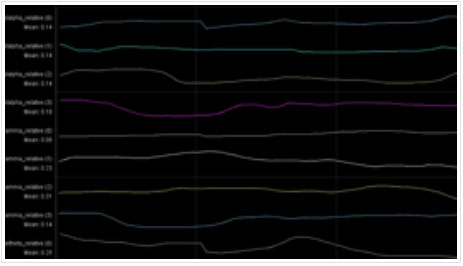
Real-time EEG readings of participant.
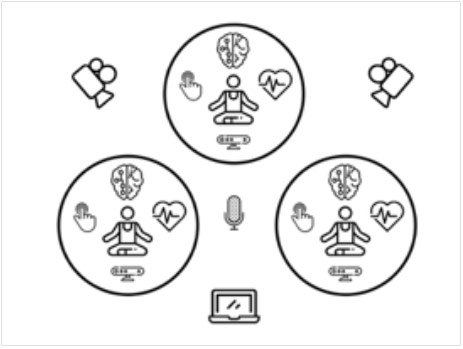
The mobile field kit captures multi-participant EEG, heart-rate variability, galvanic skin response, video, audio, motion capture, and LiDAR of the architectural space. This allows us to study practices that cultivate non-ordinary consciousness on site and in full context in a way that has never been done before.
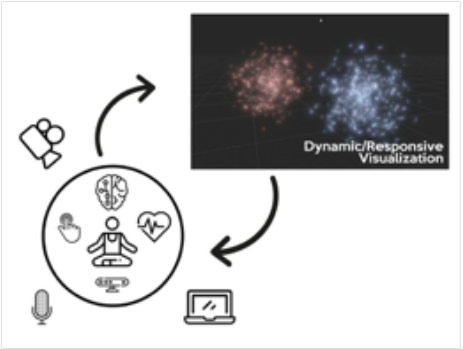
User biometrics are fed into the dynamic/responsive visualization/feedback system in real-time, allowing us to develop robust biofeedback systems built on the insights of our field research on cultural techniques for cultivating non-ordinary states of consciousness and neuroplasticity

Director Albert Lin experiencing a prototype visualization/feedback system controlled by his brainwaves and state of concentration during a session of improvised musical flow.
